

Systemization is crucial for city leaders and management to accelerate a synchronized delivery of smart cities.
DELIVERY SYSTEMS
Embedded with systems thinking knowledge, essential for navigating complex smart city delivery.
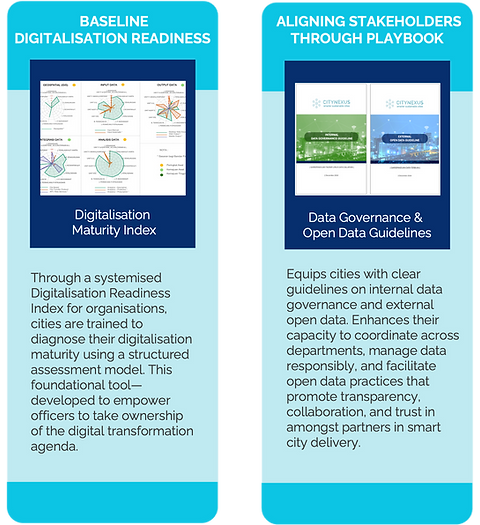
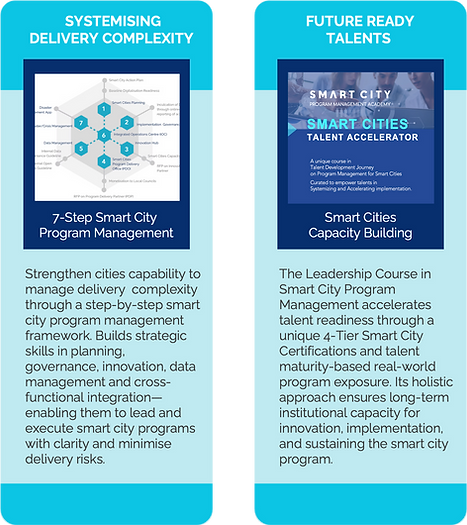
PROPRIETARY 7-STEP PROGRAM MANAGEMENT SYSTEM

Smart cities involve multiple domains, stakeholders, and delivery layers. They are best understood as the art and science of systemising complexity, providing a structured, program-led approach to translate vision into coordinated execution. By systemising delivery across these uniques seven steps, cities reduce fragmentation, de-risk implementation, and improve confidence for public and private investment.
Step 1 – Smart City Vision & Planning
Smart city aspirations are translated into a Smart City Action Plan (SCAP) at the local level. The SCAP provides a shared reference for public agencies and, where relevant, guides private sector participation and investment planning, as well as visibility on baseline digitalisation readiness of institutions.
Step 2 – Implementation Governance
Effective delivery requires clear governance. This step establishes program-level structures, including Steering and Implementation Committees, supported by defined terms of reference and decision-making authority with strong inculcation of digitalisation culture.
Step 3 – City Innovation Hub
The Innovation Hub provides a neutral collaboration platform where diverse stakeholders co-create solutions, align perspectives, and initiate initiatives in line with the Smart City Action Plan.
Step 4 – Program Delivery Office (PDO)
As initiatives scale across multiple smart city domains, the PDO acts as the central coordination function — planning, monitoring, integrating, and reporting progress across projects to ensure alignment with program objectives. It is driven by Program Delivery Partner (PDP) through Public-Private Partnership (PPP).
Step 5 – Data Management
Smart city projects generate significant data. This step establishes data pipeline and governance capabilities to enable data discovery, integration, classification, analytics, and value creation through trusted, well-managed data management playbook.
Step 6 – Intelligent Operations Centre (IOC)
The IOC operationalises the program through real-time coordination, data and decision support. It supports daily operations, incident management, and crisis response. It involves key elements on how to pre-operationalise, operationalise and sustains the IOC.
Step 7 – Disaster & Crisis Management
Resilient cities treat disaster and crisis management as a continuous program, covering preparedness, response, recovery, and post-event improvement to ensure faster recovery and long-term sustainability.
Together, these seven steps position program management as the critical layer that aligns projects to policy objectives and delivers sustained city-wide impact.